

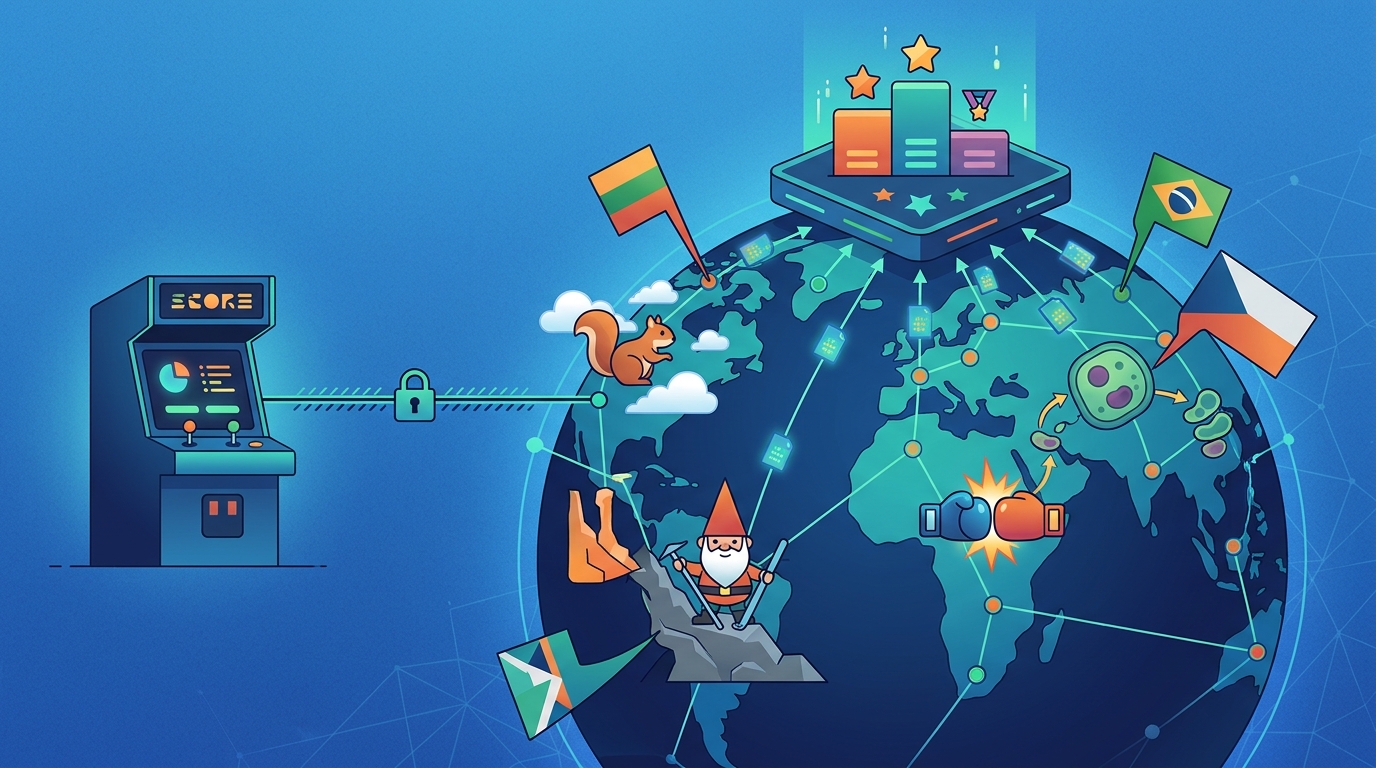
Global rankings in competitive minigames function as persistent, cross-session scoreboards that track player performance against a worldwide pool of participants. On platforms like Million Minigames, these systems use hashed player identifiers to store scores locally and sync them globally, ensuring fair, anonymous competition without requiring account creation. This architecture allows players to climb leaderboards in real-time while maintaining privacy and low-friction entry.
The Architecture of Anonymous Competition
Traditional gaming platforms often require users to register accounts, verify emails, and link social profiles before accessing leaderboards. This friction creates a barrier to entry that discourages casual players from engaging in competitive play. Anonymous global ranking is a system design where player identity is decoupled from competitive data using cryptographic hashing. In this model, the browser generates a random player ID, which is then hashed before being transmitted to the server. The server stores the hash alongside game outcomes, scores, and timestamps, allowing the platform to verify records without knowing the user's real name or email address.
This approach is critical for maintaining a healthy competitive environment. By removing the need for personal data, platforms reduce the risk of data breaches and protect user privacy. For example, when a player submits a high score in a physics-based puzzle, the system records the achievement under a pseudonymous alias. This ensures that the leaderboard reflects skill and performance rather than social influence or marketing reach. The result is a meritocratic system where the best players rise to the top based purely on their in-game actions.
Local-First Storage and Global Synchronization
Efficient ranking systems rely on a local-first storage strategy to ensure low latency and offline resilience. Local-first synchronization is a data management pattern where user data is stored on the device before being synced to a central server. In browser-based minigames, this means that game history, ratings, and saved progress are kept in the browser's local storage. When the player has an internet connection, the browser sends this data to the server for global ranking updates. This hybrid approach ensures that players can continue playing and tracking their progress even if their connection drops temporarily.
The synchronization process is designed to be seamless and non-intrusive. When a player completes a level or achieves a new high score, the browser immediately updates the local record. In the background, the system attempts to sync this data with the global leaderboard. If the sync fails due to network issues, the data remains safe on the device and is retried later. This reliability is essential for competitive play, as players expect their scores to be recorded accurately and promptly. The use of hashed IDs in this process ensures that even if the data is intercepted, it cannot be traced back to a specific individual, preserving the integrity of the anonymous competition.
Real-Time Leaderboard Dynamics
Real-time leaderboards transform passive play into active social competition by introducing visible progress and peer comparison. Real-time leaderboard dynamics refer to the continuous updating of player rankings as new scores are submitted. On platforms with frequent game releases, such as Million Minigames, new titles appear daily, ensuring a constant stream of fresh challenges. Each new game comes with its own leaderboard, allowing players to compete for the top spot in a specific mechanic or genre. This variety keeps the competitive experience fresh and prevents stagnation.
The visual presentation of these leaderboards is also a key factor in engagement. Modern platforms use dynamic interfaces that highlight top performers, recent achievements, and personal bests. For instance, a player might see their rank improve from #50 to #12 after a particularly good run in a boxing game like Odd Knuckle. This immediate feedback loop motivates players to retry and improve their scores. The leaderboard is not just a static list; it is a living component of the game that responds to player actions in real-time, creating a sense of urgency and excitement.
Ensuring Fairness and Preventing Manipulation
One of the primary challenges in competitive gaming is preventing score manipulation and cheating. Fairness enforcement in global rankings involves a combination of technical safeguards and community moderation. Platforms implement server-side validation to ensure that submitted scores are plausible and consistent with the game's mechanics. For example, if a player submits a score that is physically impossible given the game's constraints, the system can flag it for review. Additionally, the use of hashed IDs makes it difficult for cheaters to create multiple accounts to inflate their rankings, as each browser session is tied to a unique, pseudonymous identity.
Community moderation also plays a vital role in maintaining a fair environment. Players can report suspicious behavior or inappropriate aliases, and the platform's team can review these reports and take action if necessary. This collaborative approach ensures that the leaderboard remains a trustworthy reflection of player skill. By combining technical validation with community oversight, platforms can create a competitive ecosystem that is both challenging and fair, encouraging players to engage in healthy competition rather than resorting to unethical practices.
The Role of Rankings in Player Retention
Global rankings are a powerful tool for increasing player retention and engagement. Competitive retention is the phenomenon where players return to a game or platform primarily to improve their standing on a leaderboard. When players see that they are close to a higher rank, they are more likely to spend additional time playing to close the gap. This psychological effect is amplified by the social aspect of leaderboards, as players often compare their scores with friends or other top performers. The desire to be recognized and respected within the community drives sustained engagement.
Platforms that offer a diverse range of games, such as Million Minigames, benefit from this effect across multiple titles. A player who excels in a puzzle game might be motivated to try a new action game to see if they can achieve a similar level of success. This cross-game engagement keeps the platform active and vibrant. Furthermore, the introduction of new games regularly ensures that there are always new leaderboards to conquer, preventing player burnout. The combination of variety, fairness, and real-time feedback creates a compelling competitive experience that keeps players coming back for more.
Key Takeaways
- Anonymous ranking uses hashed player IDs to protect privacy while enabling global competition.
- Local-first storage ensures low latency and offline resilience by syncing data in the background.
- Real-time leaderboards provide immediate feedback, motivating players to improve their scores.
- Fairness enforcement combines server-side validation with community moderation to prevent cheating.
- Competitive retention is driven by the desire to improve one's standing on a leaderboard.
- Diverse game libraries keep the competitive experience fresh by offering new challenges regularly.
Frequently Asked Questions
Do I need an account to participate in global rankings?
No, you do not need an account to participate in global rankings on platforms like Million Minigames. The system uses a random player ID generated by your browser, which is hashed and stored locally. This allows you to play and compete anonymously without providing any personal information.
How are my scores protected from being hacked?
Your scores are protected by using cryptographic hashing for your player ID and server-side validation of submitted scores. This ensures that your data is pseudonymous and that any submitted scores are plausible and consistent with the game's mechanics.
Can I see my rank in real-time?
Yes, most modern platforms provide real-time leaderboard updates. As you play and submit new scores, your rank on the leaderboard is updated dynamically, allowing you to see your progress immediately.
What happens if my internet connection drops during a game?
If your internet connection drops, your game progress and scores are stored locally in your browser. Once your connection is restored, the system will automatically sync your data with the global leaderboard, ensuring that your scores are recorded accurately.
How can I report a player for cheating?
You can report a player for cheating by using the reporting feature provided on the platform. The platform's moderation team will review the report and take appropriate action if the behavior is found to be in violation of the terms of use.
Are global rankings available for all games?
Global rankings are typically available for most games on the platform, but this can vary depending on the specific game's design. Some games may have leaderboards, while others may focus on single-player progression. You can check the game's description or help section to see if it supports global rankings.
Start Climbing the Ranks Today
Global rankings transform casual minigame play into a thrilling competitive experience. By leveraging anonymous identity, local-first storage, and real-time feedback, platforms like Million Minigames create a fair and engaging environment for players of all skill levels. Whether you are a seasoned pro or a casual player, the leaderboard offers a clear goal to strive for and a sense of achievement when you reach it. Explore the list of games to find your next favorite challenge and start climbing the ranks today.